No. 26 Failover Weekly,
The Switch Already Thrown
Why the Control Plane Is a Dependency of Your Recovery
A recovery plan is a gate made of API calls, and the control plane is a dependency too. Here is why the capability you recover with can share fate with the thing you are recovering from, what “data plane” actually buys you, and why the most resilient switch in your architecture is often the one that is already thrown.
A retail platform. Composite again — three engagements, one shape.
Their Regional evacuation runbook was good. Reviewed, versioned, rehearsed twice a year. Eleven steps, each with an owner and a command. On the day they needed it, the bridge was open in four minutes.
Step one: sign in to the console and assume the operator role. Step three: change the weight on the DNS record. Step five: raise the desired capacity of the standby fleet from four to sixty. Step eight: update the content delivery configuration to point at the standby origin.
The team did everything right. And for long stretches, the steps simply waited.
Nothing in the plan was wrong except its assumption about what would answer. Every step asked to create or change something, and the systems that change things were having a worse day than the systems that serve traffic.
Every recovery step is a request — count which plane it lands on
Here is the reframing.
We judge a recovery plan by its logic: sequence, owners, rollback. But a plan is also a list of dependencies, and the one nobody lists is the API each step calls.
So the availability of your recovery path is not the availability of your standby. It is the availability of the least available thing your recovery path has to ask for permission.
The AWS Well-Architected Reliability Pillar states this as a best practice with an unambiguous title — REL11-BP04, “Rely on the data plane and not the control plane during recovery” — and an equally unambiguous instruction: “focus on using a minimal number of control plane operations to recover, rescale, restore, heal, or failover the service.”
Minimal, not zero. Keep that word in mind.
Two planes, two promises — and the router analogy is literal
The vocabulary is borrowed from networking, and the AWS Fault Isolation Boundaries whitepaper says so: “These terms originate from the world of networking, specifically routers. The router’s primary function is moving packets around based on rules; this is its data plane. Those rules are created and distributed from the router’s control plane.”
In cloud terms: “Control planes provide the administrative and configuration APIs used to create, read or describe, update, delete, and list (CRUDL) resources,” while the data plane “is what provides the primary function of the service.” The running Amazon Elastic Compute Cloud (Amazon EC2) instance is data plane. Launching one is control plane. Answering a DNS query is data plane. Changing the record is control plane.
The distinction matters because of complexity. Launching an instance means “finding a physical host with capacity, allocating the network interfaces, preparing an Amazon Elastic Block Store (Amazon EBS) volume, generating IAM credentials, adding the security group rules, distributing networking information to other physical hosts, and more. If any one of those steps fails, the overall Amazon EC2 instance provisioning fails.” By contrast, “Data planes are intentionally simpler than control planes, resulting in fewer dependencies, which makes them more reliable.”
Anyone who has watched a router keep forwarding while its routing process restarted already understands the idea. The forwarding path is simple and stubborn. The thing that changes it is clever, busy, and the first to suffer.
One more line from REL11-BP04 that most runbooks have never read: “While both systems are built to be very reliable, the control planes are not included in the SLA.”
Global services: a data plane everywhere, a control plane somewhere
This is where the shared fate becomes concrete.
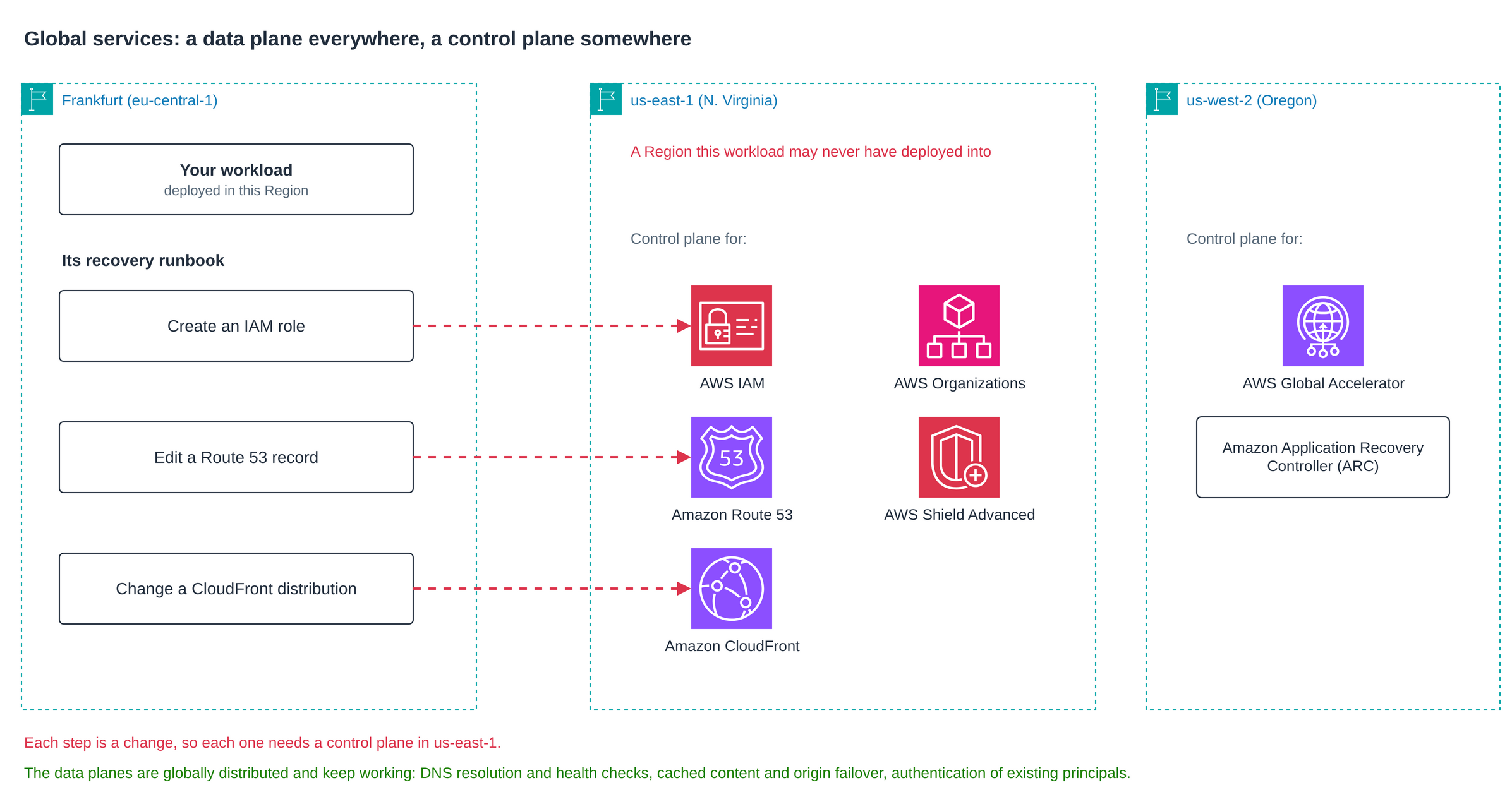
Several AWS services are global, and the whitepaper describes the pattern plainly: “their control plane is hosted in a single AWS Region, while their data plane is globally distributed.” Its table lists the control plane for AWS Identity and Access Management (IAM), Amazon Route 53, Amazon CloudFront, AWS Organizations and AWS Shield Advanced in us-east-1, and for AWS Global Accelerator and Amazon Application Recovery Controller (ARC) in us-west-2.
Read your runbook with that table beside it. If your workload lives in Frankfurt and recovery requires creating an IAM role, editing a Route 53 record or changing a CloudFront distribution, your Frankfurt recovery depends on a Region you may never have deployed into.
The honest news is that the data planes keep a great deal working during a control plane impairment, and the whitepaper is specific about what:
- IAM: “authentication and authorization for existing principals will continue to work.”
- Organizations: Service Control Policies “will continue to work and be evaluated as part of the IAM authorization process.”
- Route 53: “DNS resolution and health checks, and updates to routing resulting from changes in health checks, will continue to work.”
- CloudFront: “your content will continue to be cached and served, origin failovers will continue to work,” and existing certificates keep working, along with automatic renewals.
What stops is everything shaped like a change: CRUDL operations, including — for CloudFront — invalidation requests.
There is one development worth placing correctly. Route 53 accelerated recovery, launched a year ago, keeps a copy of an opted-in public hosted zone in US West (Oregon) and lets you “resume making DNS changes within about 60 minutes after AWS detects that the US East (N. Virginia) Region is impaired.” A real improvement for a long event. But read its boundaries: public hosted zones only, it must be turned on “before any issues with the US East (N. Virginia) Region occur,” and during failover only a listed subset of API operations works — you cannot, for example, create or delete hosted zones. A sixty-minute objective is a recovery for your ability to manage DNS. It is not a failover lever you want sitting in the first minutes of your own plan.
The quiet ones: credentials, consoles and endpoints
Credentials. The AWS Security Token Service (AWS STS) has a global endpoint, sts.amazonaws.com, alongside Regional endpoints. Since April 2025, a request to the global endpoint is served in its own Region when it comes from a Region enabled by default and the Amazon DNS server resolves it; from an opt-in Region, or through any other DNS resolver, it is still served in US East (N. Virginia). Credentials from a Regional endpoint “are valid in any Region.” The SDK setting that decides which one your code calls is sts_regional_endpoints, and the documented default is regional — with exceptions. AWS CLI v1, the SDK for Go 1.x (V1), the SDK for Java 1.x and the SDK for JavaScript 2.x default to legacy, the global endpoint. That is precisely the vintage of script that lives in DR tooling.
Break-glass access. The whitepaper’s example is the clearest statement of the principle I know. A statically stable emergency user is created in advance with permissions attached and credentials locked in a vault. The non-statically-stable version is “to provision IAM users during a failure, or having the user pre-provisioned, but only attaching the admin policy when required.” Both of those depend on the IAM control plane. Its alternative: session tags from your identity provider, evaluated against aws:PrincipalTag, so permissions change while policies stay static.
The console. The console has a global endpoint too. The guidance is to go to the Regional console directly rather than relying on the global endpoint to redirect you — and, more broadly, not to rely on a global service’s console for recovery at all. ARC’s own best practices tell you to bookmark the five Regional cluster endpoints and to change routing controls through the CLI or SDK, explicitly so that the console is not a dependency of your failover.
The inventory — the most useful hour of your quarter
What the retail team built afterwards was not a new runbook. It was a column.
RECOVERY PATH INVENTORY — one row per runbook step

step | action                        | plane    | ctrl Region | pre-stage as
-----|-------------------------------|----------|-------------|---------------------------
 1   | sign in, assume operator role | DATA(a)  | -           | Regional console + STS
 3   | change Route 53 record weight | CONTROL  | us-east-1   | health-check failover
 5   | ASG desired 4 -> 60           | CONTROL  | Regional    | pre-scaled, or throttle
 8   | edit CloudFront origin        | CONTROL  | us-east-1   | origin group failover

(a) only if role, policies and trust already exist; creating any is CONTROL.

RULE: a CONTROL row in the first hour needs an owner, a reason,
      and a data-plane alternative or an accepted risk.
Footnote (a) is where most teams find their surprise. A step’s plane depends on what must already exist for it to be a read rather than a write. The whitepaper also points at a useful primitive here: the Service Authorization Reference exposes an IsDataPlane property for supported actions, so the classification can be looked up rather than argued about.
Pre-staging: move the work to before the incident
The remedy is mostly a change of tense. REL11-BP04 lists the conversions:
- Auto Scaling (control plane) to pre-scaled EC2 resources (data plane).
- EC2 instance scaling to AWS Lambda scaling.
- In Kubernetes, “Adding pods is a data plane action… Actions should be limited to adding pods and not adding nodes.”
- A Route 53 record change to health-check-driven routing.
And the sentence for the top of every DR design review: “creating new functions, load balancers, API gateways, or DynamoDB tables is a control plane action and should be completed before the degradation as preparation for an event and rehearsal of failover actions.” The Route 53 guidance adds: pre-provision the load balancers that need DNS records.
Where full pre-provisioning is too expensive, the Pillar offers an honest alternative: “set throttles on the overall end-to-end system to safely limit the total traffic reaching the limited set of resources.” A smaller standby that sheds load deliberately is a design. A smaller standby that expects to scale on demand during an event is a wager on a control plane.
What “data plane” does not buy you
The honest boundary, because the phrase now appears in pitches as if it were a guarantee.
A data plane executes the last state it was given. That is its virtue and its limit. If that state is wrong — an origin group pointing at a standby decommissioned in the spring, a record never created — the data plane serves it with exactly the same reliability as the right one. Static stability preserves your mistakes as faithfully as your preparation.
Nor is a data plane immune. The whitepaper’s claim is careful: broad failure events are “statistically less likely to occur in the data plane than the control plane.” Less likely is not never, and a Regional data plane shares fate with its Region.
And pre-staging is a bill. Warm capacity, duplicate load balancers, idle tables in a second Region — every control plane call you remove from the incident becomes a line item you pay for on every quiet day. A legitimate trade-off, made workload by workload. Not a free upgrade.
And remember minimal. Some recovery always needs a control plane: rebuilding a replica after failback is a sequence of creates. The aim is not purity. It is that the first, most time-critical part of recovery asks nobody for permission, and the creates move to hours where a slow API is an inconvenience, not an outage extension.
The switch already thrown
Put the pieces together and a design principle falls out.
The best recovery action is not a fast API call. It is a state set in advance, so that flipping it is a data-plane operation — or nothing needs flipping at all. A health check that already gates the record. An origin group that already knows its secondary. A standby that is already large enough to carry the load. A credential that already exists, in the Region you will be standing in.
Switches already thrown. The incident only has to notice them.
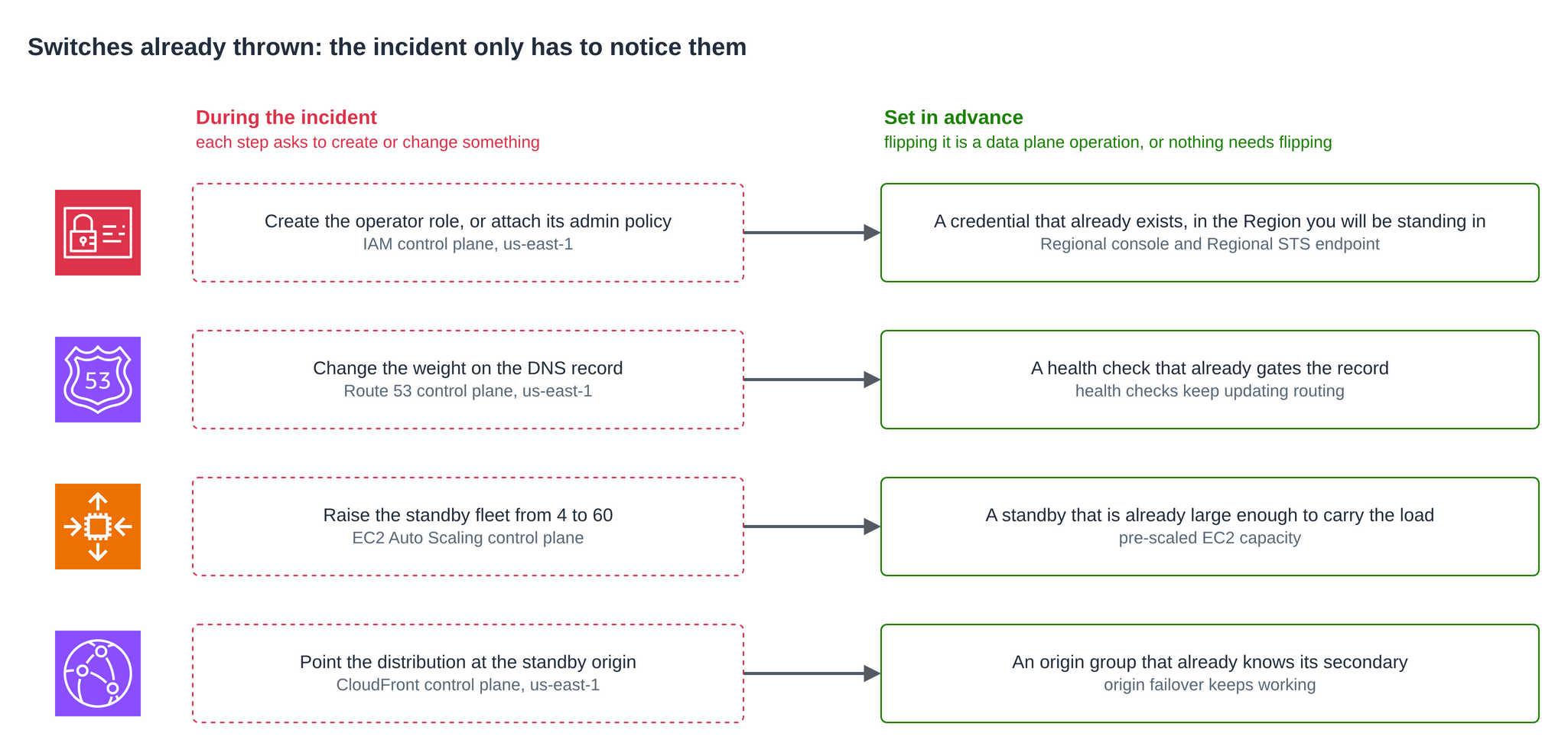
Four recovery actions that wait on a control plane during the incident, and the state each one becomes when it is set in advance.
The lesson, generalized
Any emergency procedure that begins by asking a system for permission inherits that system’s availability.
Infrastructure is just where it is easiest to measure. The incident process whose first step is “raise a ticket” in the tool that is down. The fire door with a badge reader on the same power circuit. Each reads as complete, and its weakest link is a dependency nobody wrote down because it looked like plumbing.
So add one more line to the review: what is the first step in our recovery plan that creates something — and what does it depend on?
Fire exits are not built during the fire.
What’s next
The inventory above has a weakness: it only lists the dependencies you know your runbook calls. The ones that hurt most are those your workload calls on its own — the SDK that reaches a global endpoint, the library that resolves a name in another Region, the third-party service quietly hosted next to the impaired one.
Next issue: the dependency map you did not draw. How to discover the cross-Region and global calls a “Regional” workload actually makes, using the logs you already have, how to tell a hard dependency from a soft one, and how to test that isolation on purpose before an event tests it for you.