Failover Weekly No. 3
When Drones Hit Your Availability Zones
Why the Threat Model Just Changed
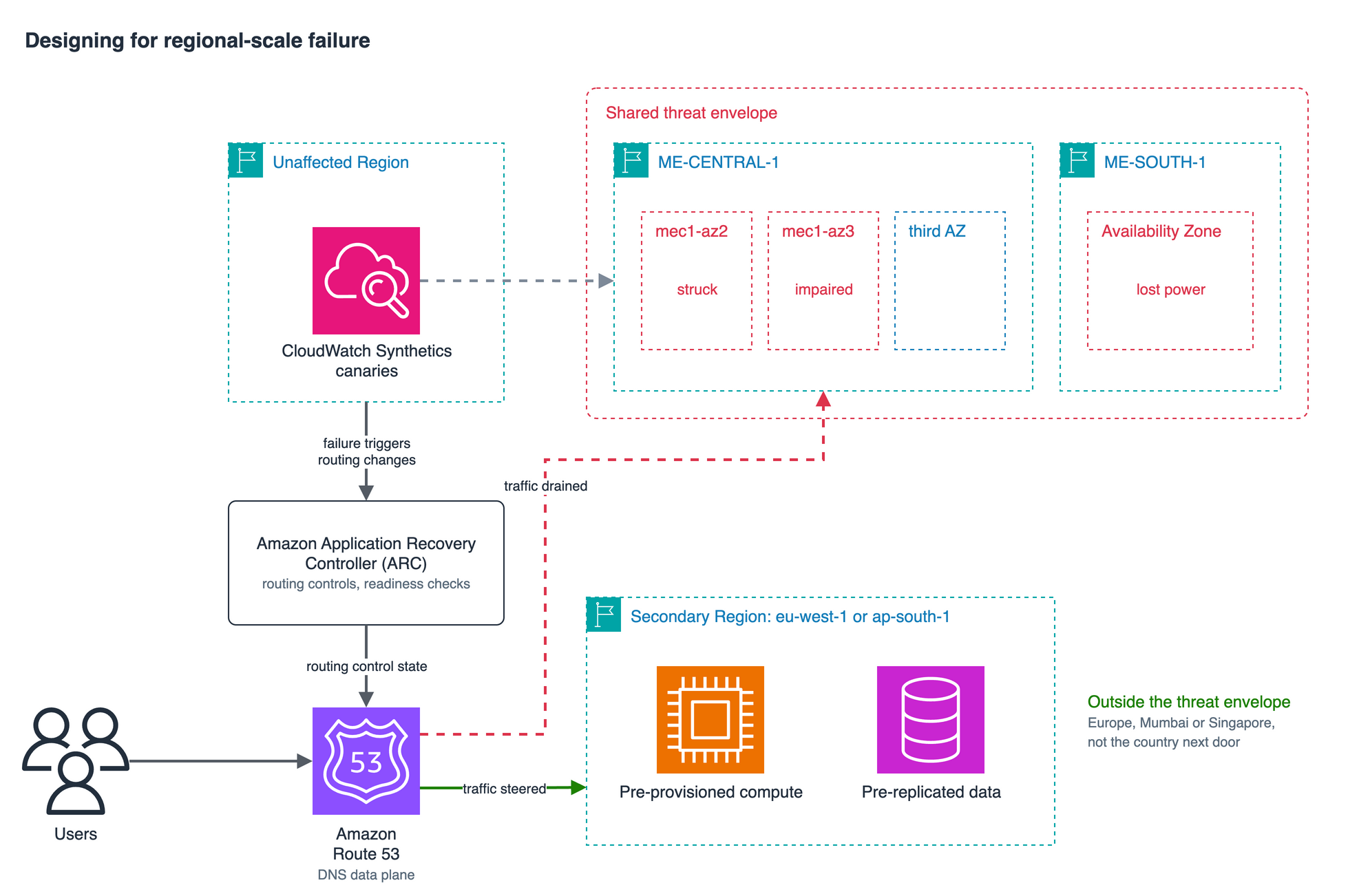
On March 1st, drones damaged three Amazon Web Services data centers across the UAE and Bahrain. Two of three Availability Zones in ME-CENTRAL-1 were severely disrupted. A single Availability Zone in ME-SOUTH-1 lost power from a nearby impact. Fire departments cut electricity — primary feeds and backup generators — to contain structural fires. Water damage from suppression activities compounded the destruction.
This was not a software bug. Not a misconfigured deployment. Not a capacity limit. This was kinetic warfare against cloud infrastructure — and it introduced a failure mode that the industry’s foundational resilience model was never designed to handle.
THE INCIDENT
AWS reported that at approximately 4:30 AM PST on March 1, 2026, Availability Zone mec1-az2 in ME-CENTRAL-1 was “impacted by objects that struck the data center, creating sparks and fire.” Within hours, mec1-az3 followed. In Bahrain, a single Availability Zone in ME-SOUTH-1 suffered infrastructure damage from a strike in close proximity.
At peak disruption, over 100 services were affected across ME-CENTRAL-1. Snowflake’s regional deployment was disrupted.
AWS confirmed “structural damage, disrupted power delivery to our infrastructure, and in some cases required fire suppression activities that resulted in additional water damage.” The company advised customers to migrate workloads to other regions and redirect traffic away from the UAE and Bahrain.
Then on March 24, Bahrain was hit again. A second wave of drone activity disrupted ME-SOUTH-1 for the second time in a single month.
The strikes were part of broader military activity in the region following an escalation in the Middle East conflict. Regardless of the specifics, the operational reality is clear: cloud infrastructure in conflict zones is vulnerable to physical destruction, and architects need to design accordingly.
THE THREAT MODEL EXPANSION
Multi-AZ architecture works. It works well. The engineering behind Availability Zone isolation represents decades of investment in independent power, cooling, physical security, and redundant connectivity. For the failure modes it was designed to handle — power outages, lightning strikes, tornadoes, earthquakes, and equipment failures — multi-AZ delivers exactly what it promises.
What the architecture did not model is sustained kinetic warfare at regional scale. Not a localized incident affecting a single facility. A military campaign where strikes land across an entire country and neighboring countries simultaneously, over multiple weeks, affecting power grids, emergency response capacity, and physical infrastructure broadly.
When two out of three AZs in a region are impaired simultaneously by correlated physical destruction, the blast radius exceeds what single-region architectures can absorb — regardless of provider. This is not a failure of multi-AZ design. It is an expansion of the threat model beyond what any cloud provider originally architected against.
AWS’s own Well-Architected Reliability Pillar has always stated that you “can use a DR strategy that uses multiple Regions.” The March events demonstrated why multi-region is not an optional upgrade for critical workloads — it is the baseline when geopolitical risk enters the equation.
The anti-pattern this exposed is not multi-AZ itself, but treating multi-AZ as sufficient for all failure scenarios. Multi-AZ gives you redundancy within a fault domain. Multi-region gives you resilience across fault domains. The distinction matters — and it matters more now.
DEFENSIVE ARCHITECTURE: WHAT ACTUALLY WORKS
The organizations that weathered this event shared a common trait: they had already designed for regional-scale failure. Here is what separates architectures that survive from those that do not.
Geopolitically diverse multi-region design. Your secondary region cannot share a threat envelope with your primary. If your primary is in the Gulf, your failover needs to be in Europe, Mumbai, or Singapore — not the country next door. Region selection is now a geopolitical decision, not just a latency optimization.
Data-plane steering independent of control plane. Amazon Application Recovery Controller (ARC) enables traffic steering through data-plane mechanisms that remain operational even when control planes are degraded. When a region is under physical attack, you cannot assume the control plane will be available to execute failover. Pre-provisioned routing controls and readiness checks are the difference between a 4-hour recovery and a 4-day recovery.
Cell-based isolation. If your architecture treats an entire region as a single deployment unit, you are accepting that region as your blast radius. Cell-based architectures partition workloads into independent, self-contained units that can be placed across geographically diverse regions. When a cell fails, the others continue operating. The key is per-cell deployment pipelines, independent data stores, and routing logic that can drain traffic from failed cells without human intervention.
Synthetic monitoring from outside the blast radius. CloudWatch Synthetics canaries running from unaffected regions can detect regional degradation faster than in-region health checks that are themselves impaired. Your observability stack cannot live exclusively inside the region it is observing. Cross-region synthetic transactions should test end-to-end paths continuously, and their failure should trigger automated routing changes.
Pre-positioned recovery capacity. When AWS advises customers to “migrate those workloads to alternate AWS Regions,” the implicit assumption is that you have capacity waiting. Warm standby or pilot-light configurations in geographically distant regions are not a cost center — they are insurance. Pre-provisioned compute and pre-replicated data in a region such as eu-west-1 or ap-south-1 are what make that migration fast. Without them, you are competing for capacity with everyone else doing the same thing.
WHAT THIS CHANGES
The March 2026 strikes were the first confirmed kinetic military attack on a major hyperscale cloud provider. The architectural lesson is not that multi-AZ is broken — it is that our threat models need updating.
We have spent a decade optimizing for software failures — misconfigurations, code defects, capacity limits, dependency cascades. Those failure modes are not going away. But we now have empirical evidence that physical destruction of cloud infrastructure at regional scale is an operational reality, not a theoretical exercise.
Multi-AZ remains necessary. It is not sufficient on its own for every risk profile. If your disaster recovery strategy assumes only one Availability Zone can fail at a time, you are designing for a threat model that no longer covers all scenarios. The new model includes correlated physical failures across multiple AZs, across adjacent regions, and across extended timeframes — because the March strikes were not a single event. They were a campaign that hit the same infrastructure twice in 24 days.
The architects who will keep their organizations running through the next regional-scale event are the ones designing for this expanded threat model today.
As Werner Vogels says: everything fails, all the time. March 2026 showed us that “everything” now includes the physical infrastructure itself.
Get Failover Weekly by email
One essay every two weeks, plus a short note when a new article is published here.