The Private Origin Trap: What CloudFront's VPC Origins Outage Actually Broke
On 16 July 2026 a single AWS fleet failed to load a routing-config update and every CloudFront distribution using VPC Origins went dark for three and a half hours — Canvas, Blackboard and Hugging Face included. The lesson isn't 'don't hide your origin'; it's that hiding it moves you onto a control plane you don't operate.
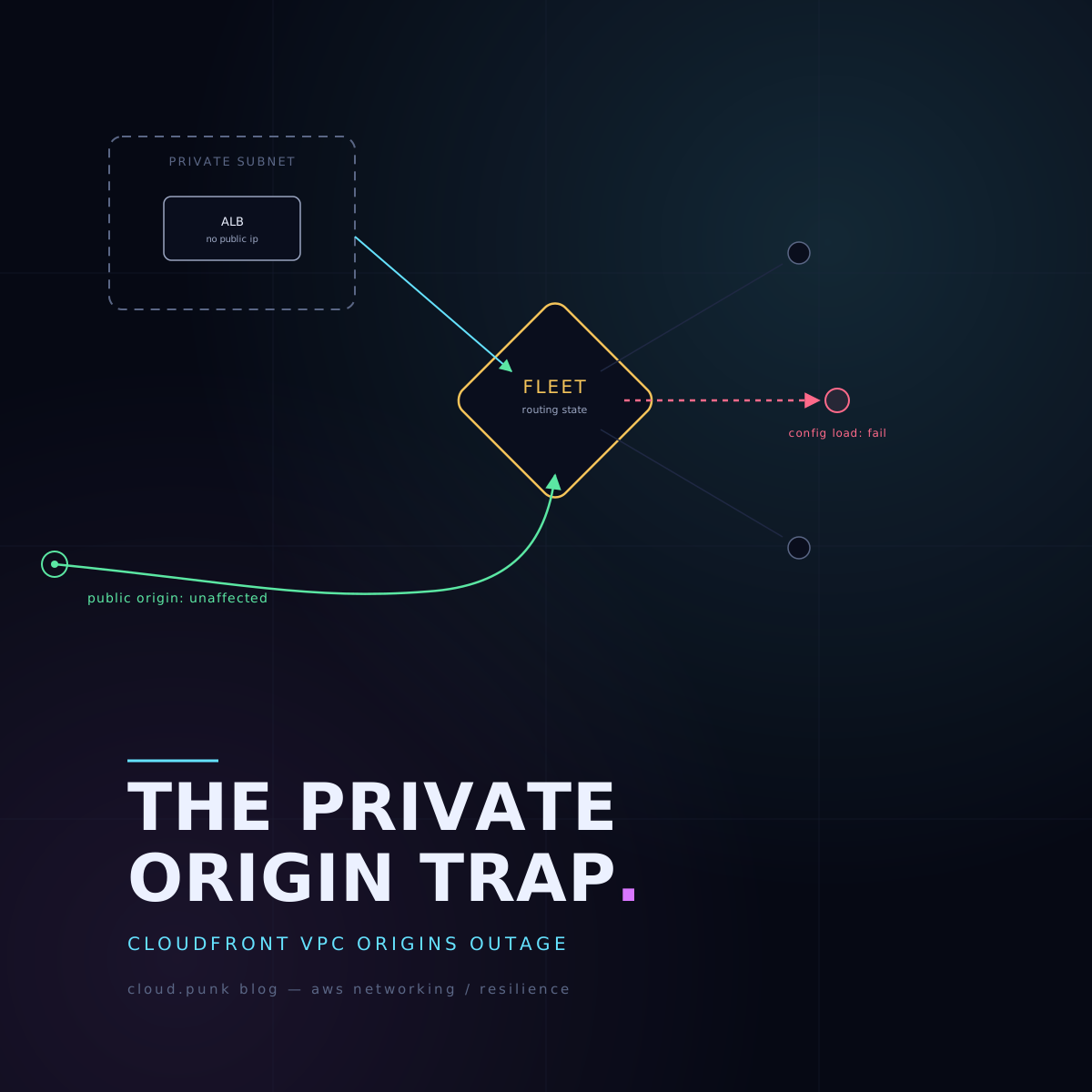
At 07:45 UTC on 16 July 2026, students logging into Canvas and Blackboard to submit summer-session coursework got 5xx pages instead. Hugging Face went dark for anyone pulling a model. The UK National Lottery’s site stopped taking traffic. None of it was a DDoS, a bad deploy on their end, or a fibre cut. It was one AWS fleet, somewhere behind CloudFront, failing to load a configuration update — and every distribution that had adopted one specific “more secure” feature going down with it, everywhere, simultaneously, for three and a half hours.
The feature was CloudFront VPC Origins, and the pitch for it was unambiguous: stop putting your load balancer on the public internet just so CloudFront can reach it. The outage is worth picking apart in detail, because the failure mode it exposed isn’t a CloudFront bug you patch around — it’s the shape of the trade you make every time you let AWS collapse a redundant path into a single managed fleet.
The problem: hiding your origin was the whole point
Before VPC Origins, putting an application load balancer behind CloudFront while keeping it off the public internet meant fighting the architecture. AWS’s own launch post is candid about the workaround it replaced: teams stitched together “access control lists (ACLs), managing firewall rules, or using logic such as header validation” to convince themselves that only CloudFront could reach an origin that was, by construction, still publicly routable. A misconfigured security group or a leaked header value and the ACL fiction collapsed.
VPC Origins, launched in November 2024, made the fiction unnecessary. Point a distribution at an ALB, an NLB, or an EC2 instance sitting in a private subnet, and CloudFront reaches it without the origin ever holding a public IP. No ACL to misconfigure, because there’s nothing public to protect. For anyone running a security review, it read as a straightforward win: fewer moving parts, one less class of exposure to audit.
What it doesn’t remove is the question of how a globally distributed edge fleet reaches a resource that, by design, doesn’t have a routable public address. Someone still has to solve that problem. It just moves from being your problem to being AWS’s.
The challenge: private reachability needs a control plane, and control planes have shared fate
A public origin is reachable the boring way: any CloudFront edge location resolves a public IP and routes to it over the AWS backbone or the public internet, same as any other client. There’s no shared state between edge locations about how to get there — reachability is a property of the network, not of a fleet AWS operates on your behalf.
A private-subnet origin has no such property. Nothing outside your VPC can route to it by design. So CloudFront has to maintain a fleet whose entire job is holding per-customer routing state — which VPC origin maps to which private ENI, over which managed path — and pushing that state out to the edge. In AWS’s own words from its incident notification, the July 16 failure came from “an internal constraint on the fleet that manages connections to private VPC origins,” and once that constraint was hit, “the system responsible for distributing routing configuration to our network processors failed to load the updated configuration data correctly, affecting routing of VPC Origin connections.” AWS did not publish a written post-event summary for this incident — as of this writing it doesn’t appear on AWS’s public post-event summaries page — but the same root-cause language was independently reported, worded identically, by The Register and by incident writeups published the same week, which is as close to a confirmed vendor statement as this one gets.
Translate that out of AWS-speak: one fleet, one config-distribution mechanism, shared by every VPC Origin on the planet, and it doesn’t respect region boundaries. Distributions using S3, or a public custom origin, or an origin behind a plain ALB kept working throughout — because they don’t depend on that fleet at all. Only VPC Origins broke, and all of it broke together. AWS’s own live mitigation advice during the incident, reported by multiple outlets, was to switch the origin type — proving in real time that the fastest way out of a VPC-Origins failure is to stop depending on VPC Origins.
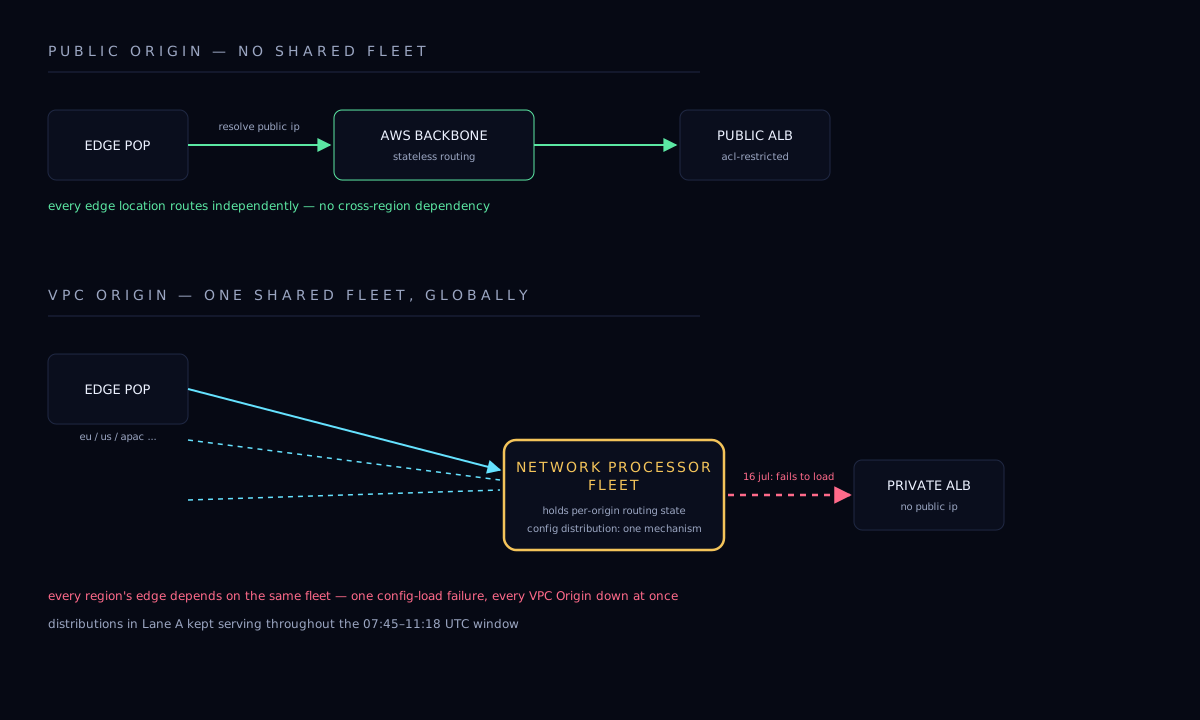
That’s the part the security-review framing misses. Moving an origin behind VPC Origins doesn’t just remove a threat (public exposure); it adds a dependency (a fleet-wide, AWS-operated control plane) that you cannot see into, cannot scale independently, and cannot fail over on your own schedule. The threat you removed was one you could mitigate with a WAF rule and a security group. The dependency you added fails correlated, globally, without warning — which is a strictly harder failure mode to design around, not an easier one.
The solution: design for the fleet, not just the origin
None of this is an argument against VPC Origins. It’s an argument against treating it as a drop-in, failure-free replacement for a public origin rather than as a new dependency that needs the same failover discipline you’d give any single point of failure.
CloudFront already ships the tool for this: origin groups with failover. Pair your VPC Origin as the primary with a secondary that does not depend on the same routing-state fleet — a public custom origin sitting behind its own security group and WAF web ACL, or an S3 bucket serving a static fallback for read paths. Configure the failover status codes to include 502, 503, and 504, and CloudFront will route around a primary that’s returning connection failures or timing out, without you touching anything during the incident.
Timeouts matter here more than usual. CloudFront’s defaults are a 10-second connection timeout across three attempts and a 30-second origin response timeout before it gives up on the primary. One customer’s own log analysis of the July 16 incident found p95 latency pinned at roughly 30.3 seconds for the duration of the outage — the exact shape you’d expect from every request riding out the default read timeout with no secondary origin configured to catch it. A distribution with an origin group and shorter timeouts (CloudFront allows response timeouts down to 1 second) fails over in a fraction of that.
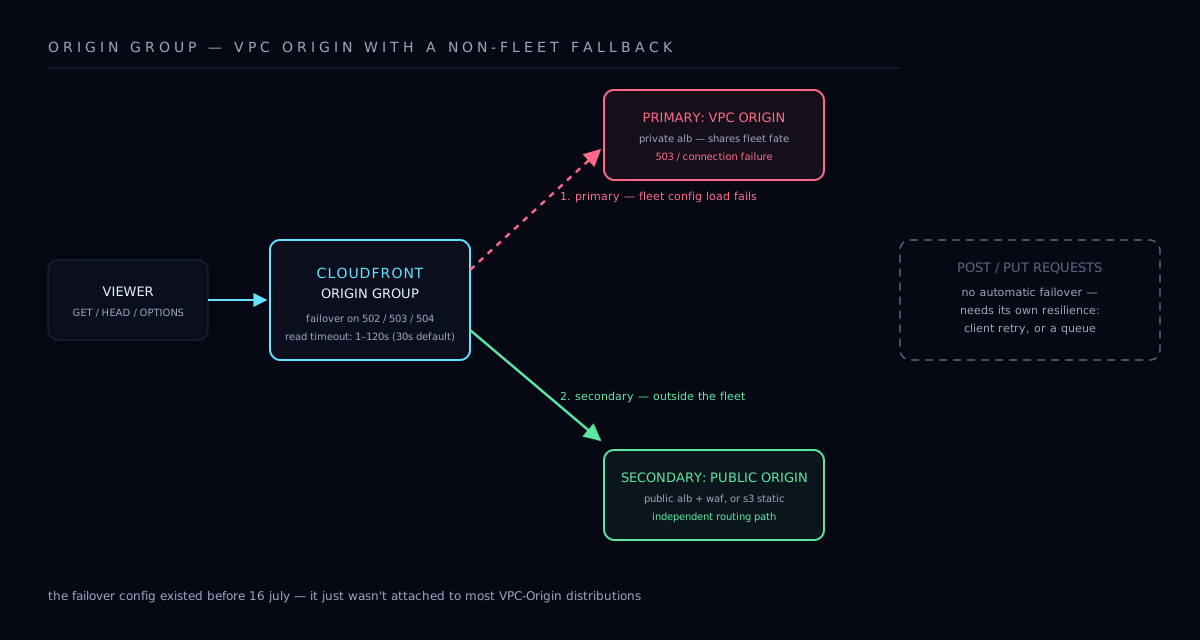
Know the limitation before you rely on it: CloudFront only fails over
for GET, HEAD, and OPTIONS requests. A POST to a VPC-Origin API
during a fleet-wide config failure gets no automatic rescue — that write
path needs its own resilience story, whether that’s client-side retry
with backoff, a queue in front of the origin, or simply accepting that
mutating requests are down when the primary is down and building your
SLA around that reality rather than assuming origin groups cover
everything.
The practical audit, for anyone running distributions on VPC Origins today: find every distribution where a VPC Origin is the sole origin, with no origin group and no fallback. Those are the ones that go dark the next time this fleet hits its “internal constraint,” and right now the only mitigation available to them mid-incident is a support ticket asking AWS to change their origin type — which is what customers were doing by hand on 16 July while a config-driven fix was already sitting one Terraform apply away.
The footprint
The instinct VPC Origins plays to — get the origin off the public internet, remove a whole category of exposure — is correct. Keep doing it. But every AWS feature that collapses a redundant, customer-operated path (public IP plus ACL plus WAF) into a single AWS-managed fleet is trading a risk you could see and mitigate for one you can’t: a shared control-plane dependency with every other customer on the same feature, failing on AWS’s schedule, not yours. That trade is usually still worth making. It is never worth making silently.
The habit worth taking from 16 July isn’t “audit VPC Origins” and stop there — it’s a standing question for every managed-simplification feature you adopt: what happens when the fleet behind this hits its constraint, and have I built the exit ramp before I need it, or am I planning to ask AWS for one over a support ticket while the outage clock runs.