Every Packet Twice: What AWS Multipath Resilience Actually Buys You
AWS now copies each cross-Region packet over physically diverse backbone paths and keeps whichever arrives first, with a 99.999% daily SLA. The mechanism is sound. The SLA's small print decides which of your paths it actually covers, and the quiet ones are not among them.
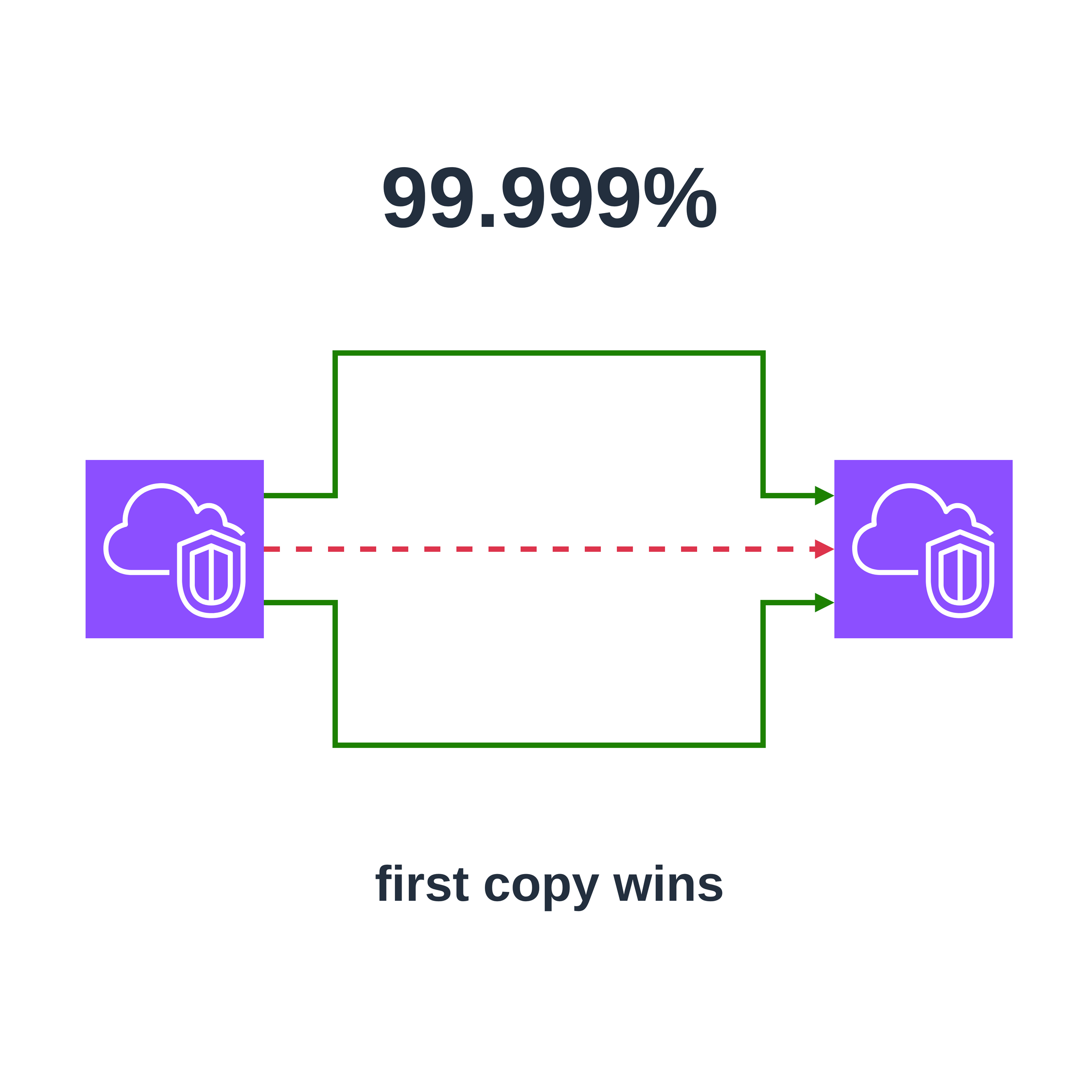
Five nines, measured per day, is 0.86 seconds. That is the whole budget. Not 0.86 seconds per incident, not per month: one bad second on a Tuesday and the day is gone.
That is the number AWS put on the table on 17 November 2026, when it announced a 99.999% availability SLA for cross-Region traffic over VPC peering, Transit Gateway and Cloud WAN, delivered by a new capability called Multipath Resilience. The mechanism behind it is old-school and brutal in the best way: send every packet more than once, over physically different fibre, and keep whichever copy shows up first.
I have spent a lot of my career explaining to customers why “the backbone is redundant” and “your application never notices a backbone failure” are two different sentences. This launch is AWS closing the gap between them, for some traffic, on some paths, under some conditions. The conditions are the interesting part.
The problem: redundancy that still takes time
AWS’s own description of the backbone is honest about where the pain is. Regions are connected over physically diverse fibre paths, and when a path fails, “the network’s automatic sub-second rerouting moves traffic to a healthy path.” Fine. Sub-second is good.
Then the next sentence: “In the rare event that such mechanisms do not resolve the issue in a timely manner, such as when there’s a partial degradation, it might take minutes for connectivity to be reestablished.”
That is the failure mode that hurts. A clean fibre cut is easy: the link is down, the routing protocols see it, traffic moves. A link that is mostly working, dropping a fraction of packets, is the one that keeps winning path selection while it quietly ruins your day. The feature page puts the range at “anywhere from a few seconds to several minutes while routes reconverge”, and names what that breaks: time-sensitive transactions, and live voice, video and broadcast. AWS’s announcement goes further and says some applications, payment processing and financial trading among them, “can’t tolerate single-digit seconds interruptions, let alone minutes of unavailability.”
The challenge: your application cannot pick a path
The workarounds AWS lists are the ones I have watched teams build, and they are all expensive in their own way.
You can split one connection into several, at the application or operating system layer. Multipath TCP is the standard version of this: RFC 8684 “provides the ability to simultaneously use multiple paths between peers.” It is good engineering, and it needs both ends to speak it. AWS’s feature page describes customers “refactoring applications to use Multipath TCP (MPTCP)”.
You can replicate your data into every Region so the critical call never leaves one. That moves the problem from the network into consistency, and turns a networking budget into a data platform programme.
Or you can keep the workload on premises, which AWS’s feature page names as what customers have done with their most availability-sensitive workloads.
The deeper problem is the one AWS states in a single line: these workarounds “don’t always work, because applications can’t control which network paths their traffic takes.” Opening four TCP connections does not guarantee four fibre routes. You are guessing at a topology you cannot see.
The solution: replicate at the edge of the backbone
Multipath Resilience moves the guessing into the only party that can see the topology. When it is on, “each packet entering the AWS inter-Region network is replicated across diverse paths on eligible AWS global backbone paths, recalculated against real-time capacity.” At the destination it “delivers the first arriving packet to your application and automatically discards the duplicates.”
If one path drops a packet, a copy is already in flight on another. Nothing waits for reconvergence, because nothing needs to reconverge for that packet to arrive. Your application keeps one connection and sees each packet once.
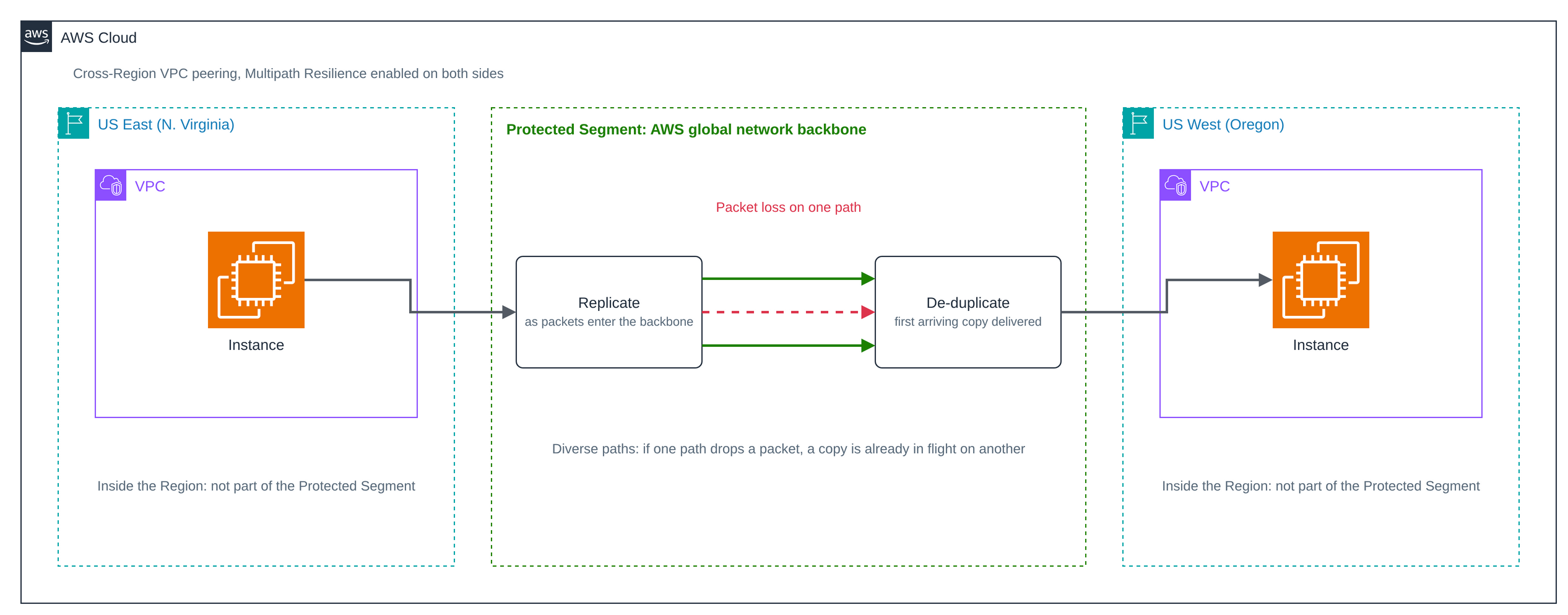
Replicated as they enter the backbone, de-duplicated before they leave it. Only that stretch is covered.
Two design details matter. First, AWS says packets travel the lowest-latency path in normal operation, so the feature is “designed to add no additional latency in steady state and can reduce jitter compared to single-path delivery.” Second, the replication is bounded: the SLA defines a Protected Segment that starts at the Multipath Resilience infrastructure next to the source Region and ends next to the destination Region, and “does not include any part of the Network Path inside an AWS Region.” Everything between your instance and the edge of the Region is still yours to make resilient.
How you turn it on, per construct
The three supported constructs behave differently, and the differences are operational, not cosmetic.
VPC peering. Cross-Region only. The peering documentation calls it “bilateral consent”: both the requester and the accepter must enable it on their side before replication starts, and either side “can disable multipath resilience on its side at any time.”
Transit Gateway. It applies to peering attachments, “not to VPC attachments or other attachment types”, and it needs the same consent from both sides. Your VPC-to-TGW hop inside a Region is not part of it, which matches the Protected Segment exactly.
Cloud WAN. No handshake: a core network is a single-account construct,
so you declare it in the
core network policy.
An empty "multipath-resilience": {} block covers every eligible pair of
edge locations; an edge-sets list scopes “coverage and billing to just
those routes”. Pairs outside the supported Regions are rejected at policy
validation. Because policies are immutable, enabling it means a new policy
version.
At launch the supported Regions are US East (N. Virginia), US East (Ohio), US West (N. California), US West (Oregon) and Europe (Ireland). If your recovery Region is Frankfurt, this is not for you yet.
What it costs
You pay per GB sent, on top of everything you already pay. AWS’s own VPC pricing example: 100 GB from N. Virginia to Oregon over a peering connection costs $2.00 of inter-Region transfer plus $3.00 of Multipath Resilience, $5.00 in total. On that path the protection costs more than the transfer it protects. Between N. Virginia and Ohio the Multipath Resilience rate is $0.015 per GB instead of $0.03.
Through Transit Gateway the same 1 GB goes from $0.04 to $0.07: $0.02 data processing, $0.02 transfer, $0.03 Multipath Resilience. Data received carries no Multipath Resilience charge on any of the three.
That pricing is the argument for Cloud WAN edge sets. If one pair of Regions carries the payment flow and the rest carry log shipping, scope the feature to the pair that matters.
The small print: which minutes count
Here is where I would slow down before telling a risk committee “five nines”.
The SLA measures each Network Path, which it defines as one direction of traffic between two endpoints. Each direction is measured on its own. A second is an Unavailable Second when more than 10% of packets are lost in it. Each path must also deliver at least 99.9% of its packets over the day.
But only Qualifying Minutes are measured, and a minute qualifies only if the path carries at least 250,000 packets in it and no single flow on the path exceeds 1 Gbps.
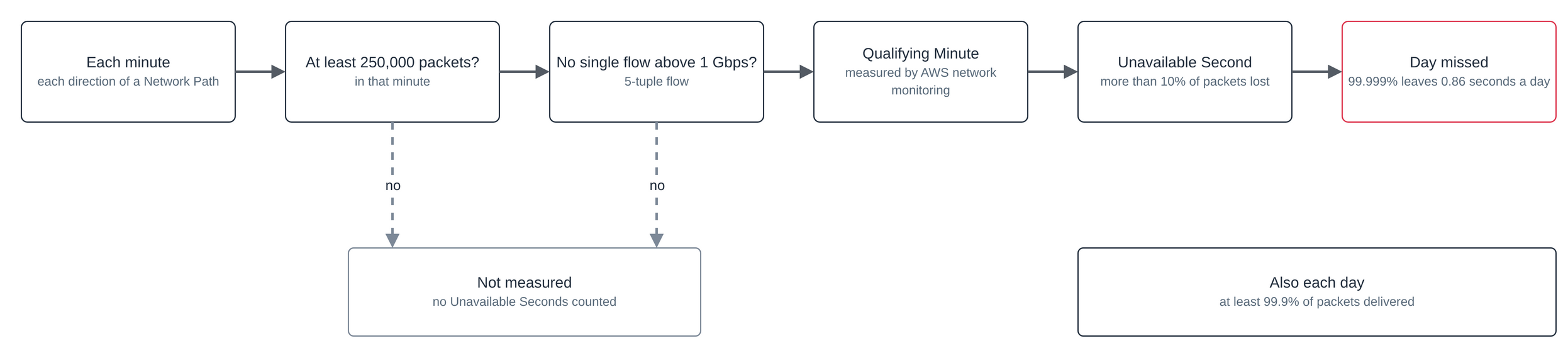
Only busy minutes are measured, and one bad second spends the whole day.
Read those two thresholds against a real architecture.
250,000 packets a minute is roughly 4,200 packets a second, sustained for
the whole minute. A busy payment path clears that easily. A warm-standby
replication link that idles at a trickle until the day you fail over does
not, and a minute it does not qualify in is a minute the SLA does not
measure. The CloudWatch metrics say the same thing from the other side: for
MultipathResilienceAvailabilityToPeer, “minutes with too little traffic to
measure always show 100.” A dashboard of 100s on a quiet path tells you the
path was quiet, not that it was healthy.
The 1 Gbps ceiling bites the other way. One fat flow, a bulk database copy over a single connection, and that minute is out of the measurement too.
Then the remedy. Service credits are a percentage of the Multipath Resilience charges for the affected path on the day, from 10% for a day between 99.99% and 99.999% up to 100% below 95%. They do not touch “the underlying inter-Region data transfer charges”, a credit is only issued if the day’s total is over one US dollar, and it is your “sole and exclusive remedy”. As with every SLA, the credit is not the point; the engineering commitment behind it is.
Finally the exclusions include “turning off Multipath Resilience on a connection” as a customer action. On a cross-account peering, the accepter can do exactly that, on their side, at any time. If the other end of your critical path belongs to a different team or a partner, that is now a change-control conversation you need to have.
The footprint
This is a genuinely useful primitive. Putting packet-level replication across diverse paths behind a checkbox on a peering connection, with no application change, is a real shift for the workloads that have stayed on premises because of minutes-long cross-Region gaps.
What I would take away from it:
It protects the backbone, not your path. The Protected Segment stops at the edge of each Region. Your instances, subnets, route tables, security groups and the in-Region hop to the transit gateway are outside it, and misconfigurations of exactly those are excluded from the SLA by name. Five nines on the middle of the path does not make the path five nines.
Measure what it measures. Watch
MultipathResilienceSLANonCompliantSecondsToPeer, and graph the minimum of
MultipathResilienceAvailabilityToPeer per direction. Then check whether
your path is actually busy enough to be measured at all.
Spend it where packets are expensive. At $0.03 per GB on top of transfer, this belongs on the flows where a lost second costs more than the bill: transactions, market data, live media, voice. Scope it with Cloud WAN edge sets or enable it per peering, not everywhere.
Do not confuse it with Regional recovery. It keeps a working cross-Region path working through a backbone fault. It does nothing for a Region that is itself impaired. That is still the job of your recovery plan, and of the checks that prove your standby can actually take the load.
Five nines is 0.86 seconds a day. AWS has now made that promise for the part of the path it owns. The rest of the 0.86 seconds is still yours.
Get new articles by email
One essay every two weeks, plus a short note when a new article is published here.